Food
What is flash-freezing?
Flash-freezing is a process that maximises the preservation of nutrients, colours, taste and aroma by bringing food to the freezing point much more quickly than a traditional freezer.
This optimises the preservation of meals and allows us to offer you a practical solution with complete peace of mind.
Comment est-ce possible de ne pas avoir d’eau dans la liste d’ingrédients de vos aliments pour bébé alors que c’est presque toujours un ingrédient présent dans les produits pour bébés?
Even before we started developing our organic and natural baby meals, we looked at feedback from a wide range of manufacturers and retailers of healthy, locally sourced baby food to understand what parents concerned about their little ones’ health thought of what’s currently available on the market. Like them, we were surprised by the list of ingredients in some ready-made baby products, despite them being marketed as ‘nutritious’.
Many parents questioned the nutritional quality of baby purées and meals, in which water was listed among the first ingredients (the earlier an ingredient appears on the list, the greater its quantity relative to other foods). Water is essential, we agree, but it provides no nutrients.
This has therefore become an integral part of our mission: to offer baby meals with no added water, made with simple, local and nutrient-rich ingredients! To achieve this, we first had to prioritise the well-being and health of little ones. Next, we developed a process to create a creamy, natural purée that is easy to swallow without compromising on texture.
We’ve also added a dash of cold-pressed virgin olive oil, a high-quality ingredient renowned for its nutritional benefits for babies, added after cooking (during the final stage of production) to provide an unrivalled creaminess and a homemade texture.
Olive oil? Yes! Healthy fats (or ‘fat’) are essential for a baby’s development and help them feel full. Don’t worry about the amount: the quantity is small, as indicated by its position in the list of ingredients.
Finally, as suggested by the Canada’s Food Guide, make water your drink of choice for your baby
Have you considered that your baby meals contain some of the most common allergens (such as milk, eggs or soya)?
OH YES! Laurie herself is allergic to peanuts, nuts (with a few exceptions), shellfish, and used to be allergic to lentils and bovine protein. And that’s just her food allergies…
Dealing with allergies is part of her daily life, and she says it so often: The one thing I hope not to pass on to any future children is my allergies!! She compares allergies to a predator that follows her wherever she goes.
Recent studies have shown that the risk of developing allergies does not decrease by delaying the introduction of allergens; quite the opposite, in fact. Studies conducted over the last decade suggest instead that the early introduction of allergenic foods may prevent food allergies in high-risk infants. That is why we have not hesitated to introduce trout, edamame (soya), beef (bovine protein), chickpeas and lentils.
Consult your doctor before introducing allergens.
At what age can I start giving my little one your healthy, natural baby meals?
The recommended age for introduction on our packaging, i.e. 9 months and older, is based on the normal development of a baby’s oral-motor skills. That said, our meals are versatile! You can adapt the texture to suit your baby’s development: puréed, mashed or in chunks. Therefore, the age of introduction may vary depending on the texture chosen! Please note that it is important to have introduced the various allergens individually first before offering our meals, which contain a variety of ingredients.
Consult your doctor to confirm the introduction of complementary foods for your baby.
Why aren’t there any fruits in your healthy, natural baby meals?
First of all, let’s not get into the tomato debate!! We are well aware that the tomato is a fruit strictly speaking, but it is eaten as a fruit-vegetable, whether raw or cooked.
As mentioned in the answer to the question How is it possible that water isn’t listed among your ingredients when it’s almost always an ingredient found in prepared baby food ? Even before we set about designing our healthy and natural baby meals, we conducted extensive research through the comments of a wide range of local and organic baby food manufacturers and retailers to validate what parents concerned about their little ones’ nutrition had to say about the current market offering.
We are well aware that fruit is ubiquitous in baby food products. However, many parents expressed concern about added fruit in everything offered to their babies, even in savoury baby meals such as chicken casseroles and beef stews.
The source of their concern stems mainly from the fact that having fruit in baby meals contributes to developing a sweet tooth in their little one. Instead, we should encourage babies to enjoy the taste of vegetables, without adding any sugary foods!
Of course, fruit is excellent for a baby’s health, but let’s not forget the super antioxidant and nutritional power of fresh, local vegetables! For these reasons, it was very important to us that our baby meals with no added sugar contain only healthy and nutritious vegetables, and to encourage parents to offer fruit as a side dish, at lunch, as a snack or as a dessert.
Your baby meals are described as ‘complete, healthy and balanced’ – what does that mean?
As outlined in the 2019 update to Canada’s Food Guide, the importance of enjoying a variety of healthy foods EVERY DAY – namely vegetables and fruit, whole grains and protein – has been emphasised.
As we are committed to meeting the highest nutritional standards to support your little one’s optimal development, we have ensured that each of these three components is included in all our meals, with a distribution aligned with the proportions recommended by the guide and the paediatric professionals with whom we collaborated on the recipes. Thanks to this formulation, every bite is complete!
Have you considered serving your meals in portions?
OF COURSE!! During our various tasting sessions with baby testers, we asked parents to measure the portion consumed by their baby. Our aim was to determine a specific weight so that we could offer our meals in pre-defined portions!
Well, dear parents, you won’t be surprised to read that there is NOTHING more variable than a baby’s appetite—not even the weather!! It’s not just a question of one baby’s appetite compared to another’s. NO WAY!! The same baby can have a completely different appetite from one day to the next! This variability can be explained (among other things!!) by: the amount of milk consumed during the day and at night, the quality of sleep, the size of breakfast and snacks, age, stage of growth, mood, teething, the amount of water consumed during the meal, whether they’re a big eater or not…
After several brainstorming sessions, we concluded that THE best solution was to let parents portion out the food themselves for their little ones. The GOOD NEWS is that our meals are easy to portion, as they aren’t filled with water (so they’re not a block of ice!!). The desired amount can be easily portioned using a spatula, a spoon or a knife, to name just a few examples!
PRO tip: We recommend starting with a small portion and adjusting if the amount proves insufficient. This way, you avoid food waste 😊 Don’t forget to put the uneaten portion back in the freezer until your next meal!!
How many meals does one portion provide?
As mentioned in the previous question, “Have you considered serving your meals in portions?”, it was impossible to determine a precise weight that would perfectly suit the appetite of every baby. For example, a 9-month-old baby might eat 25 grams, just as a 6-month-old might eat the same amount. Several factors influence the appetite of our adorable little ones (plenty of examples above!!) As such, it is your baby’s appetite that will determine the number of portions.
Even today, my little Flavie, aged two and a half, devours Belov every day. Yes, yes, our meals are nutritious, even for children her age, and let’s face it, dear parents, 24 hours in a day just isn’t ENOUGH 😅 At her age, she eats between half and three-quarters of the pot.
Are your meals based on baby-led weaning (BLW)?
Our meals are designed for ALL babies in Quebec, REGARDLESS of the feeding method chosen by the parent. Our aim is to offer healthy and tasty food, without categorising children based on one approach or another. Each method has its advantages (and its disadvantages!!) and what is important, FIRST AND FOREMOST, is that your little one gets all the essential nutrients for their healthy development.
It’s important to note that even with the self-feeding approach, purées are part of a baby’s diet, and even with the traditional approach, solids are part of a baby’s diet!! Yes, yes. Most of us associate self-feeding with chunks and traditional feeding with purées. Whereas what distinguishes one method from another is whether the baby brings the food to their mouth themselves, rather than with mum or dad’s help. If baby uses a spoon to eat yoghurt or fruit purée by themselves, that is indeed self-feeding! At a few months old, they probably won’t have the grace of royalty with their spoon, but they’ll be just as cute!
Finally, don’t feel guilty about taking a personalised approach! In reality, observing your baby should be a priority, and ultimately you need to adapt to them! Let’s keep in mind that the most important thing is to ensure your baby gets all the essential nutrients for their healthy development through nutrition, which plays a key role in this regard! Let’s also not forget that iron-rich foods are essential!
Why do you leave the skins on most vegetables when you cook them?
We’ve all heard that you should peel vegetables before eating them. This advice, which seems sensible, isn’t always necessary! You need to look at the nutritional value of vegetable skins to understand why. For most vegetables (and even fruit!), the skin is packed with micronutrients in MUCH higher concentrations than the flesh itself. In fact, vegetables (and fruit!) are mainly composed of water, with some containing as much as 95% water. For example, aubergine skin contains fibre, flavonoids and magnesium, whilst the flesh has a water content of around 90%! So, by keeping the skin on, the nutrient intake is significantly higher! That said, it is true that for some very young children, vegetable skins can be more difficult to manage. Therefore, it is important to be vigilant and monitor your child’s developing skills to determine their ability to eat a meal containing vegetables with their skins on.
Consult your doctor before introducing vegetables with skins to your baby.
Why is texture emphasised in each of your product ranges?
First and foremost, our greatest desire is to be your everyday NINJA ally. In other words, to support you as a parent for as long as possible and not leave you in the lurch by offering a solution that becomes obsolete too quickly! To be a daily nutritional ally, we had to offer products that would be suitable for babies as early as possible in their development and that would continue to be nutritious for their constantly evolving needs.
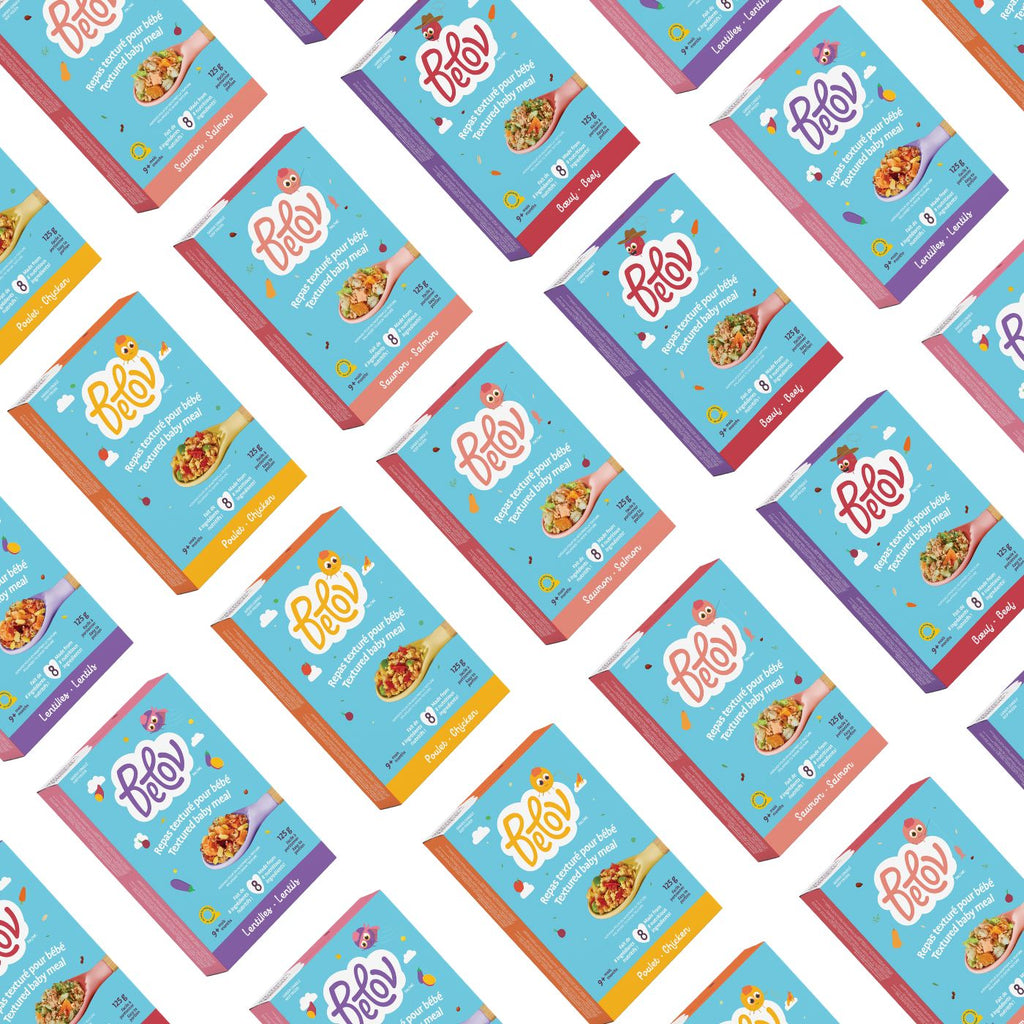
In doing so, rather than opting for puréed meals, we’ve focused on TEXTURED MEALS! That said, it’s true that texture preferences vary from person to person – there’s no accounting for taste, as they say! Our aim is to provide nutritious meals for all little ones, so the good news is: OUR MEALS ARE VERSATILE! You can serve them in their original form, i.e. in chunks, or adapt the texture to suit your baby’s preferences and the development of their skills: mashed or puréed. We cannot stress this enough: every baby is unique, and you need to be attentive to their needs, rather than imposing one texture or another (chunks, mashed, puréed).
We highlight the word ‘textured’ on our packaging, and in reality, we’re referring to ALL textures, as long as the one chosen suits your baby 😊 Introducing different textures should be safe and enjoyable for our little ones.
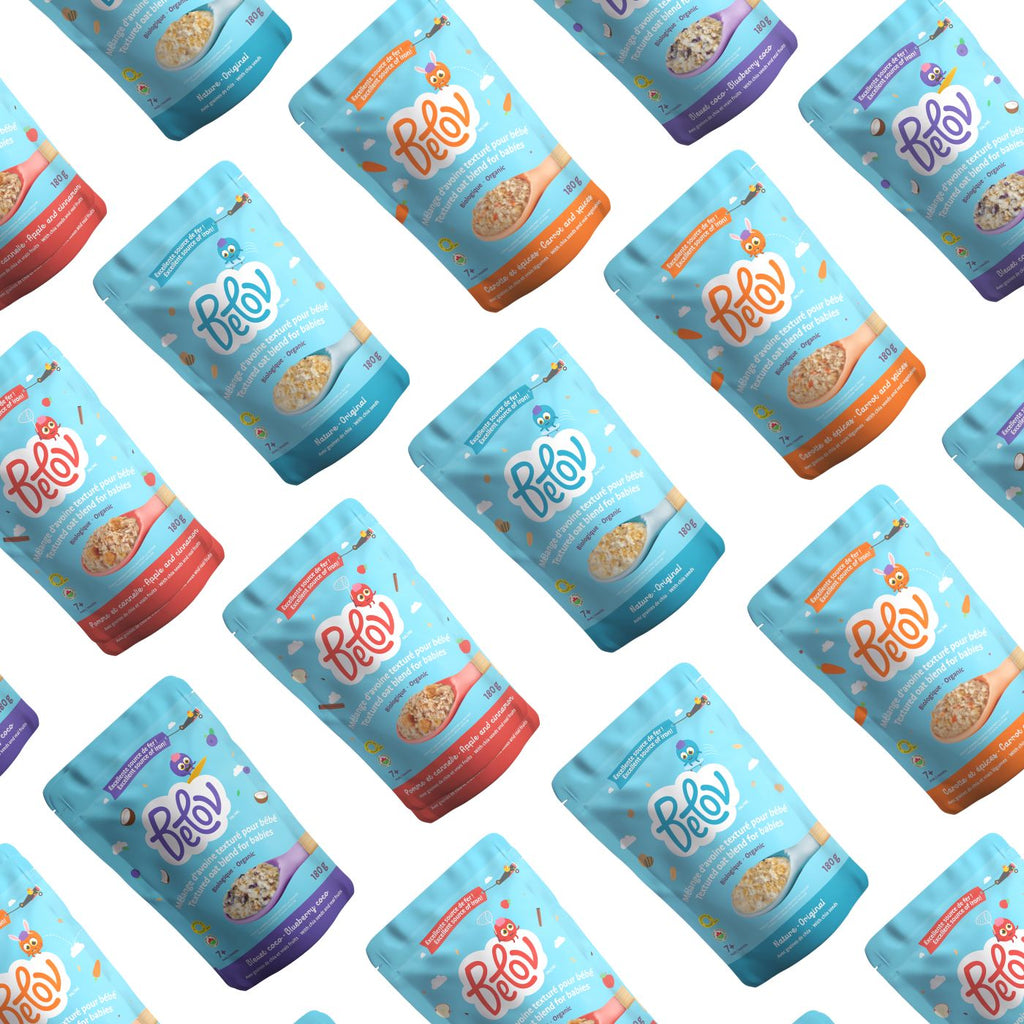
When it comes to our oat blends, we wanted to offer babies the comforting experience of a more traditional porridge! What’s more, Belov is committed to innovation!! Putting another traditional cereal on the shelves—one we might describe as ‘powdered’—wasn’t in line with Belov’s mission. Our tasty blends can even be added to baby’s favourite recipes: muffins, pancakes, etc.! OHH YESSS! As they’re enriched with iron, we help you contribute to the recommended daily intake! OHHH WOOOWWWW!
For your range of dry products, namely the textured oat blends, why did you opt for whole oat flakes?
Interestingly, traditional baby cereals are processed! More specifically, the grain undergoes a process known as enzymatic hydrolysis. Through this process, the starch (a polysaccharide) is broken down into smaller sugar molecules to aid digestion. Hydrolysis also helps to sweeten the mixture. Thank goodness we worked with a food chemist to understand all these complex terms!!
So, during the cereal R&D process, we asked ourselves whether marketing a traditional cereal (with a full understanding of what this product actually is…) was in line with Belov’s values and with developments in infant nutrition. After careful consideration, we came to the conclusion that it wasn’t! What’s more, Belov’s innovation must be reflected across all our products. As a result, we channelled our resources into developing textured oat blends for toddlers that would be fortified just like traditional cereals (a benefit that’s nothing to be afraid of!).
Did you know that iron deficiency is the most common deficiency up to 24 months of age?
We therefore needed to develop a product that would support parents until their little one reaches 2 years old! By choosing rolled oats rather than powdered cereal, we’re making way for TEXTURE! What’s more, it’s important to introduce lumpy textures by 9 months at the latest to prevent the child from developing certain aversions. So, with textured blends, we’re helping parents meet their child’s daily iron needs for longer!
Are your textured oat blends organic?
YES, all our oat blends are organic! The best part is that our oats come from a local family-run business!! Yes, yes, from St-Félicien, QUEBEC, CANADA!
Why have you fortified your textured oat blends with iron?
When it comes to irreversible delays in cognitive development, this is not a situation to be taken lightly. We were therefore committed to helping reduce the risk of iron deficiency by developing iron-fortified oat blends to help parents meet the recommended frequency of iron-rich foods for their babies, up to the age of 24 months.
Here is an excerpt from Health Canada’s infant nutrition guide:
By around six months of age, the iron stores of older infants are depleted (IOM, 2001; Butte, Lopez-Alarcon, and Garza, 2002; Dewey and Chaparro, 2007). The risk of iron deficiency increases between the ages of six and 12 months, as rapid growth during this period requires a large amount of iron (Institute of Medicine, 2001). The risk remains present between the ages of 12 and 24 months. Indeed, studies indicate that the nutritional quality of a young child’s diet and their intake of key micronutrients, such as iron, tend to decline (Picciano et al., 2000).
The risk of iron deficiency can be reduced by introducing iron-rich complementary foods such as meat or meat substitutes and iron-fortified cereals at the right time and consuming them regularly (Butte et al., 2002; Dewey and Chaparro, 2007; Meinzen-Derr et al., 2006). Between the ages of 6 and 12 months, infants should be offered iron-rich foods at least twice a day. From 12 to 24 months of age, children should consume iron-rich foods at every meal.
Why are your puffs now 7M+?
With the support of paediatric occupational therapists, we have confirmed that our puffs are suitable from 7 months rather than from 9 months.
They remain the same, but are simply available a little earlier in your little one’s development. Enjoy! 🐣
My order
What should I do if there is an error in my delivery address?
If you notice an error in your delivery address, please contact us within 24 hours of placing your order by emailing info@hellobelov.com.
We will do our best to make the changes if the order has not yet been processed or dispatched.
⚠️ After this 24-hour period, the order may already have been prepared or dispatched. In this case, we cannot guarantee any changes nor can we be held responsible for an incorrect address provided at the time of ordering.
Please note that it is the customer’s responsibility to carefully check the information entered when confirming their order.
What are the delivery charges?
Delivery charges are calculated based on the total amount of your order:
- $0 to $124.99: $9.99
- $125 and over: Free delivery
Shipping charges (may vary by region):
- $0 to $174.99: $19.99
- $175 and over: $14.99
Do you deliver anywhere in Quebec?
To ensure the freshness of our frozen products, we only deliver to certain areas where delivery is guaranteed within48 hours. If your postcode isn’t recognised when you place your order, get in touch with us! We’ll check if we can add your address to our delivery area.
Important information regarding the delivery of frozen products
We use a specialised service to maintain the cold chain (insulated cool boxes, dry ice, ice packs, etc.). It is essential to track your shipment and place the products in the freezer as soon as you receive them.
We are committed to ensuring the products remain frozen until they arrive at your home. Once the order has been delivered, it is the superparent’s responsibility to store the products correctly. :)
If you plan to be away at the time of delivery, please don’t hesitate to get in touch!
What is the delivery time for my order?
We dispatch orders once or twice a week, depending on volume, usually between Monday and Wednesday. This schedule may vary on public holidays. Once your order has been processed, you will receive an email containing your tracking number. Delivery then takes 24–48 hours, depending on your region; we always use an express service.
- If you place your order on a Monday or Tuesday, you will usually receive it within 2 days.
- For orders placed later in the week, delivery may take between 3 and 6 days.
Why is there a minimum spend of $65?
To ensure your meals arrive nice and fresh 🥰, we use ice packs and special packaging to maintain the cold chain. The minimum order of $65 helps us cover these costs and guarantee that your meals are always delicious and safe!
Tips and advice
Up to what age can I provide your meals?
Our products are aimed at children aged 6 to 24 months. This period covers the introduction of complementary foods and extends until the end of the crucial first 1,000 days of life (including the duration of pregnancy). This phase is crucial for an individual’s health and is the ideal opportunity for parents to provide all the benefits of a healthy and varied diet! Furthermore, during the first few months of a child’s life, it is not recommended to add salt or sugar to their meals (WHO, 2009) and our products are in line with this guidance. HOORAY!
On our packaging, the recommended age for introduction is indeed 9+ months, but the texture can be adapted for early introduction (please refer to the question “At what age can I start offering your meals to my baby?”).
IN FACT, our products can also support the nutritional needs of young children, and even adults. YES, YES! Of course, we realise that the portion size of our products is a tad too small for an adult! However, we encourage you to taste the “Belov” difference; you’ll be pleasantly surprised by the quality and flavour of our products. We PROMISE, you and your baby won’t turn up your noses!
Consult your doctor to confirm the introduction of complementary foods and your baby’s nutritional needs.
Why do you recommend cooking on the hob rather than in the microwave?
We prefer the stovetop cooking method for various reasons!
Firstly, we have been informed of the toxicity of certain materials when heated. More specifically, although some plastics are advertised as ‘microwave-safe’, particle migration can occur… It’s all quite complex, so for the rest of this, we’re putting on our super SCIENTIST hats!!
There are several types of plastic, and each has its own specific melting point. However, even if the melting point of a plastic, such as PET, is 255°C, the particles that make it up become agitated when it is heated. How can you heat plastic at home? It’s quite simple, dear parents!!! When we heat food in the microwave in a plastic container, its temperature rises as a result, causing the particles it’s made of to move about, which can lead to these particles migrating into the food. Not very SHARP, let’s face it…
Given that this information isn’t readily available to the general public (we practically had to take a chemistry lesson to understand all this, haha), we prefer to stick to cooking on the hob. That way, we avoid contributing to increased exposure to plastic particles migrating into baby food. HOWEVER!!! If you use a glass or porcelain container to reheat baby food in the microwave, don’t worry – there’s no potential for particles to migrate from these materials 😊
Secondly (and much less complicated), we prefer this method of preparation for the final result it produces! Indeed, the food will have simmered gently over a low heat for a few minutes, resulting in an unrivalled harmony of flavours!
What’s more, you’ll find that the aroma is all the more intense and truly delightful for anyone lucky enough to catch a whiff of our meals!! Finally, it might just be us, but using a small saucepan and stirring a few times during cooking gives us the feeling that we’ve spent hours whipping up this delicious baby meal – IT’S LIKE A REWARD!! Keep it simple 😉
Why do you suggest adding water when cooking meals?
This tip has been added to the stovetop preparation instructions to prevent the meal from sticking to the bottom of the pan. In fact, as the ingredients defrost, the parts touching the bottom of the pan could BURN!! Your baby may not be able to speak, but they’ll certainly let you know they’re not happy if you serve them a burnt meal! By adding water, the ingredients can thaw gently and then simmer, giving your baby a creamy and delicious meal 😊 As suggested on our packaging, you can even replace the water with any other thickening agent: stock, sauce, vegetable purée, etc. The choice must, of course, be with no added salt or sugar ! Also, parents who decide to introduce our meals before 9 months can make it easier to manage the different textures by adding a larger quantity of the chosen thickening agent or even mashing the meal with a fork or reducing it to a purée.
When preparing food in the microwave, adding a binding agent is optional depending on the microwave’s power and, of course, on your baby’s ability to handle the pieces as they are or to prefer a different texture (mashed or puréed). For example, if you want to serve the meal mashed, adding water or any other thickening agent will give you a creamier texture!
The important thing to remember is that, as a parent, YOU are the BEST OBSERVER of your little one 😊 Every child is unique, and so is their development. The transition to different textures can be a worrying step for parents, so it’s better to err on the side of caution! If you’d like to gradually introduce grainy textures to your baby and eventually make the transition to chunks without a binding agent, that’s fine too! Let’s remember that the most important thing isn’t the method or the texture, but that your baby gets all the essential nutrients for their healthy development!